


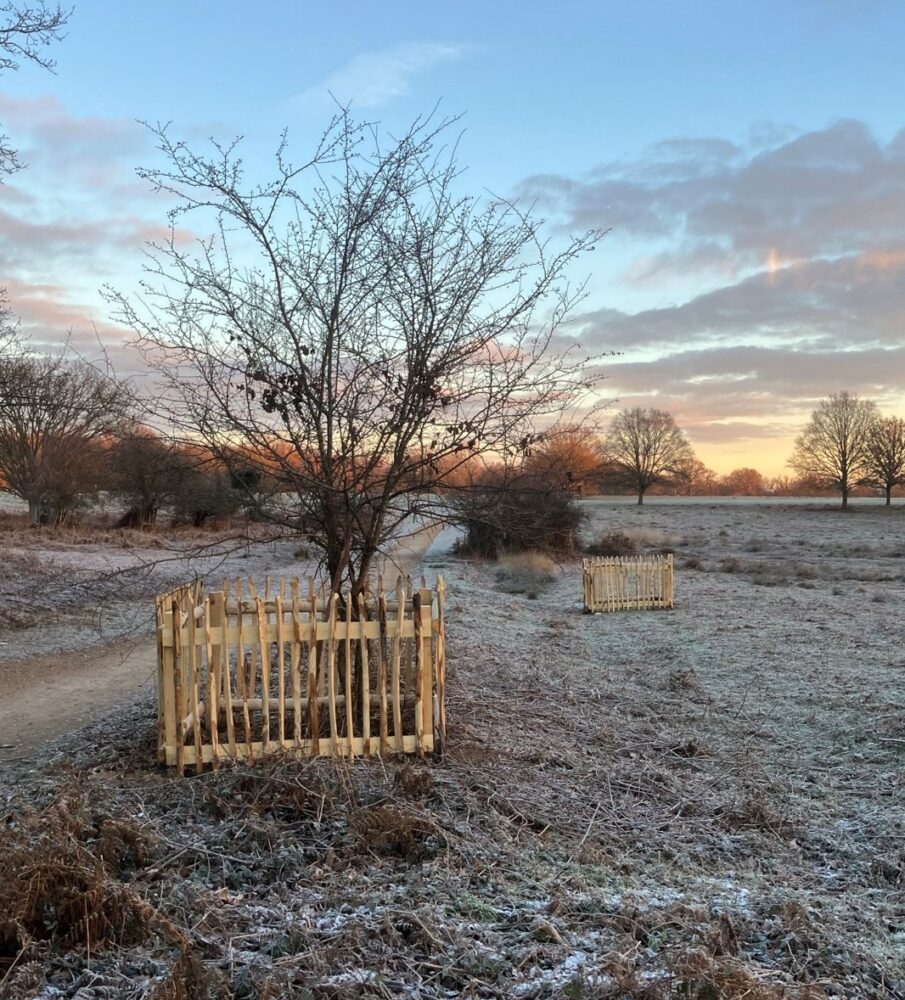
Main picture: Hawthorn protection funded by The Friends
The Friends funds hawthorn protection in the Park
Park visitors may recently have noticed new structures around hawthorn trees and bushes, especially around the slopes of Sawyer’s Hill and near the rugby pitches. These chestnut wood crates are designed to protect the shrubs from deer, who will potentially strip the hawthorns and eat the bark and who particularly enjoy young hawthorns.
Hawthorn trees and bushes are a true cornerstone species for the British countryside in general and specifically within Richmond Park. The beautiful blossom, in creamy white and pink, is a stunning sight during spring and its nectar is vital for a range of pollinators including butterflies (such as the yellow tip), many species of moth, including both the hawthorn moth and the hawthorn berry moth, many species of bees, and hoverflies. The highly nutritious red berries (haws) are a crucial winter food for many birds including thrushes, blackbirds, fieldfares, woodpeckers and waxwings and are also consumed by small mammals.
The Friends are pleased to have funded these crates and ensure that the Park’s rich biodiversity will benefit from the protected hawthorns.
A very early breeder
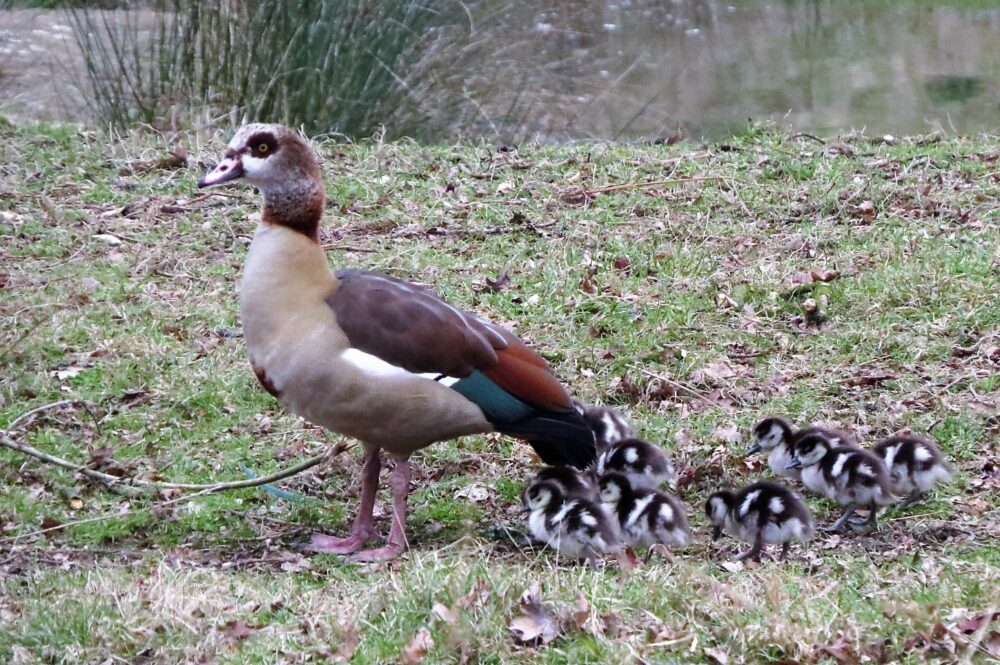
Photograph: Nigel Jackman
Originally introduced to England as an ornamental species, the Egyptian Goose has recently significantly expanded in numbers and distribution including the London area, and in Richmond Park too. Loud and rather striking birds, particularly when revealing their white wing patches in flight, they have the distinction of breeding very early, between February and June but sometimes starting in January.
Egyptian Geese form lifelong monogamous pairs and typically lay eight to nine eggs, favouring large old trees with suitable cavities for nesting. Oddly they are not geese at all, but more closely related to shelducks – a sub-species of ducks. However, consistent with the species name the young continue to be described as goslings.
Sir David Attenborough talks about Richmond Park
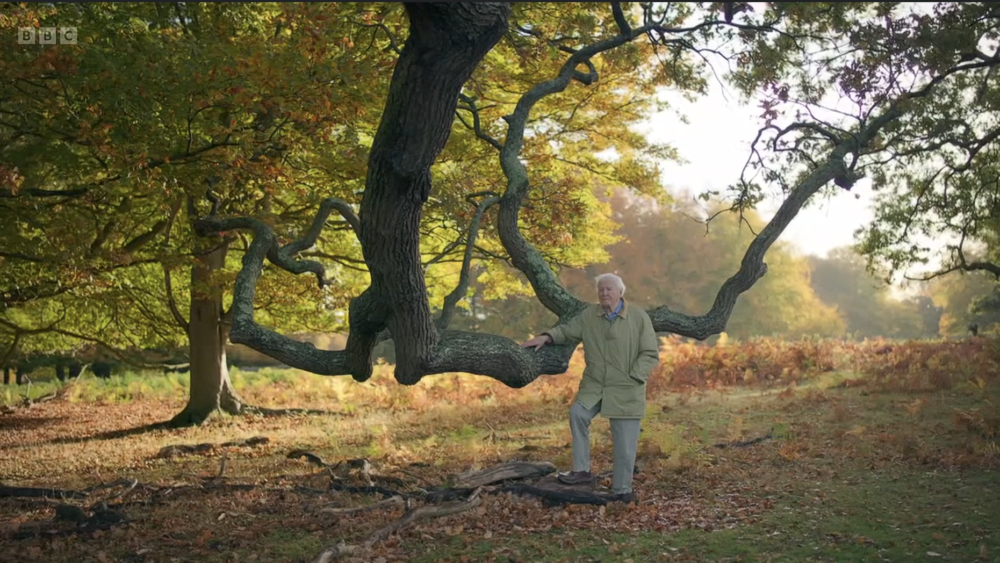
Photograph: BBC – screenshot from ‘Wild London’
We enjoyed watching ‘Wild London’, our patron Sir David Attenborough’s latest documentary.
At the end of the programme he said:
“Standing among these marvellous trees, it’s hard to believe that I am in a capital city. Richmond Park is one of my favourite places. Just minutes from my house, it’s been both a refuge and a source of inspiration over the years.
I have been coming here ever since I moved to London over 70 years ago. Even after all that time and after all the places I have visited, I wouldn’t want to live anywhere else.”
The programme is currently available on BBC iPlayer.